Cobots: automation without the fortress
Collaborative robots work safely alongside your team — smaller footprint, faster deployment, easier re-programming and a significantly lower entry cost than traditional industrial cells. For Victorian manufacturers with high product mix, limited floor space or their first automation project, a cobot cell is usually the right place to start.
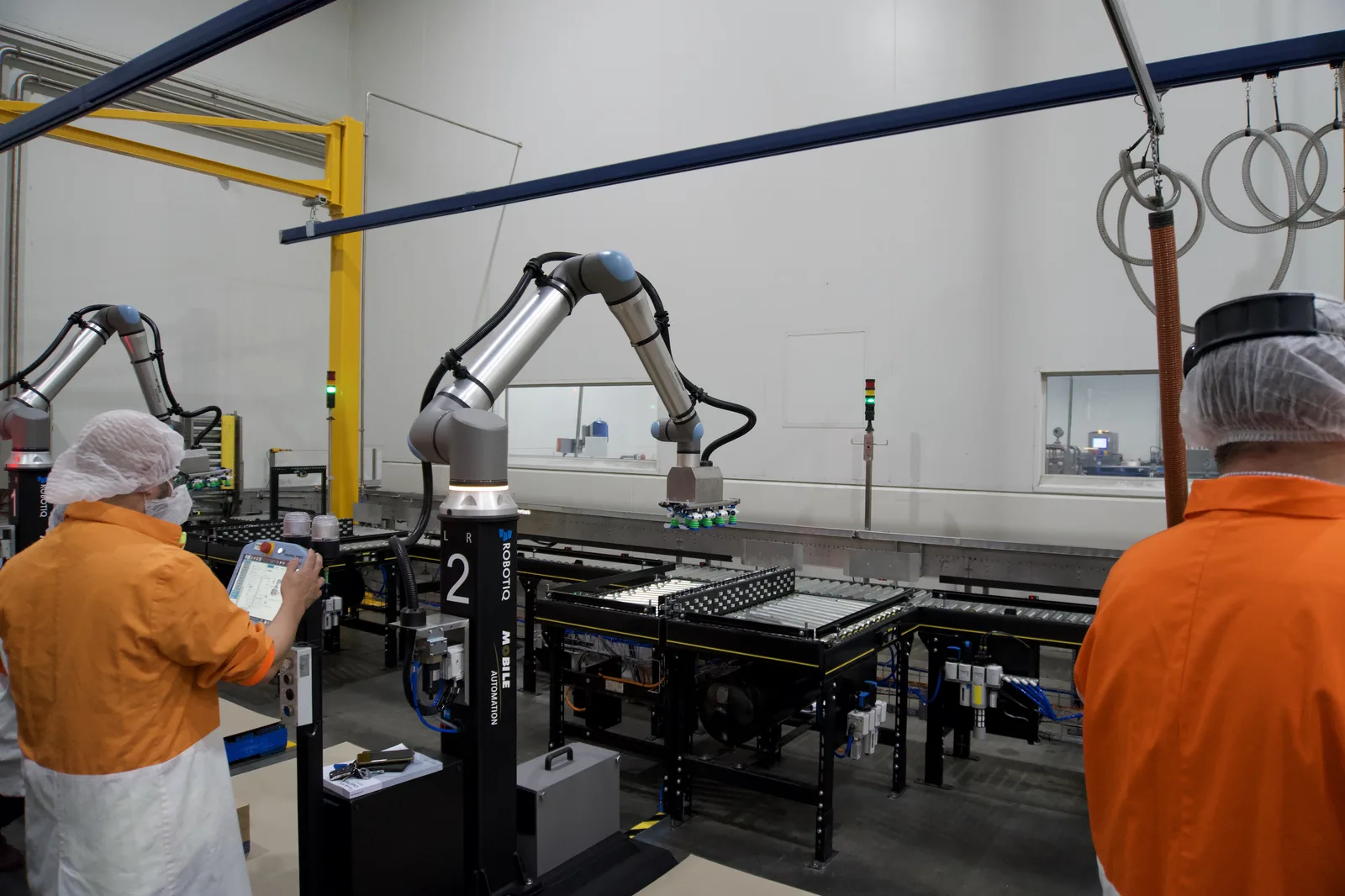
Mobile Automation has been delivering collaborative robot solutions for years, including some Australian firsts — we deployed the first collaborative robot box erector in the country. We're certified across the Universal Robots range (UR3e through UR30) and are an experienced Robotiq partner for grippers, force sensors, vision systems and palletising bases.
Where cobots fit best
- Palletising — low-to-medium rate end-of-line palletising, like our three-UR20 dairy system handling 40 boxes/minute across 95+ SKUs
- Machine tending — loading and unloading CNCs, presses and moulding machines, including lights-out running
- Welding — cobot MIG welding for fabricators, like the twin UR10 cells that lifted Rockpress's productivity by 40%
- Pick & place, packing and assembly — vision-guided handling, carton erecting, screwdriving and inspection
The honest bit: cobots still need engineering
A cobot out of the box is not a solution — it's a component. It still needs tooling, integration with your line, a documented risk assessment to AS/NZS 4024 (yes, even collaborative robots), and depending on payload and speed, area scanners or partial guarding. That engineering is exactly what we do in-house: electrical, mechanical, controls and safety, with 24/7 support afterwards. It's also why our cobot systems keep running after the novelty wears off.
Fast payback, low disruption
Cobot cells typically deploy in weeks rather than months, and simple applications running multiple shifts can pay back in 6–18 months. Because they're mobile and re-programmable, the same robot can move to a new task as your production changes — we train your team to redeploy it themselves.
Frequently asked questions
What's the difference between a cobot and an industrial robot?
Cobots are designed with force limiting and rounded geometry to work near people at reduced speeds, and typically handle up to ~30kg. Industrial robots are faster and stronger but need full guarding. We deliver both and will tell you honestly which your application needs — sometimes it's cheaper overall to guard a faster industrial robot.
How much does a cobot cell cost?
As a general guide, complete cobot cells typically land between $80k and $250k installed depending on tooling, conveyors and safety requirements. We provide fixed quotes after a site assessment and simulation.
Do collaborative robots need a safety assessment?
Yes. Collaborative operation must be validated by a risk assessment to AS/NZS 4024 — payload, speed, tooling and product all affect the outcome. We design and validate the safety system in-house as part of every project.
Which cobot brands do you supply and support?
Primarily Universal Robots (UR3e–UR30) with Robotiq tooling and palletising systems — platforms with deep local spares and support. We'll also integrate other collaborative platforms where the application calls for it.
Can our own team learn to program it?
Yes — that's the point of cobots. We include operator and maintenance training in every project; on our Laverton dairy project we trained four site 'system champions' in robot and PLC programming.